fbpx
  • An update on life with two rescue dogs

    Two cute dogsIt’s now been 10 months since adopting Leila, and 5 since adopting Max. Life with two dogs is never dull.

    Neither had normal lives. Each was a little over a year old when we got them. She’d spent most of her life at the SPCA, and while we don’t know much about Max’s background – he had recently been brought in by an inspector – it doesn’t seem like he was in a great situation. He had big scars on both ears apparently from flystrike, which still haven’t totally healed to invisibility, and his coat was in horrible shape.

    Bringing home a second dog

    They got along swimmingly at the meet and greet, and we brought him home that afternoon. Later that evening, when she realised he wasn’t leaving, though, she started growling at him. There were some scuffles and scraps those first few days, but they’ve bonded really strongly. He in particular seems to miss her when they’re apart and get nervous (he’s a worrier!) and they get along 99% of the time. I thrive on all the cute moments when they’re nuzzling and grooming each other. And then I sigh at all their tussling; they warned us that he has a rough play style, and she’s totally embraced that. They rough and tumble a LOT.

    Max had a lot of accidents inside to start with, and it took probably close to two months for his stomach to settle, poor boy. Runny poos for weeks upon weeks, and he even had a worm or two when he first came home with us. It took probably three months for his coat to lose its dry, strawlike, shedding condition. Now it’s shiner with deeper, bronzy hues and it makes me so happy to see that.

    Of course they had to teach each other the worst of their habits….

    She never used to go stealing kibble out of the bag (which we used to leave in the laundry room, unsealed) or rooting around in the rubbish bin. Now – after one particularly epic mess in which they tore up a nearly full bag and gorged on a fair bit of it – the food is now off limits in a cupboard.

    He was never the slightest bit reactive to other dogs, but having been party to some of her overreactions out in public, he now echoes her barking and pulling if she reacts. Oh, and he does this weird thing of tucking one paw under the rest of that leg, which she’s started doing.

    There were lots of rough moments for a few months. We’d been making progress with training Leila out of jumping up (at people), which regressed because of Max and his jumping tendencies. Their rough and tumbling was a bit extreme – constantly playing chase around the house, tearing around through the garden and because we got him in winter, lots of mud tracked through the house after racing around outside in the yard. And there are moments of sibling rivalry from time to time.

    The good, bad and ugly

    They are opposites.

    She’s smart and a quick learner, and clean (and quiet). He’s dopey, prone to farts, a snorer.

    She’s fairly good off lead though her recall is definitely not perfect – especially when other dogs are around. Once, winter storm winds blew our gate open during the day, but she didn’t leave the yard. On lead, she’s still prone to pulling until she’s worked off a bit of that initial energy at the start of the walk. He’s good on lead but prone to running away in general – it was a nightmare those first few months. Squeezing through the fence, bolting out the front door, etc, and we can’t trust him off lead yet.

    But she’s definitely the special needs one. They say collies are the most neurotic of dogs, which rings true for her. Her quirks have always been endearing. But one in particular is proving rather trying (well, aside from the carsickness!).

    She’s always been very dog reactive. From the beginning, she’d sometimes freak out if we saw other dogs and she couldn’t interact with them. Pulling, crying, whining, barking, whatever. We were working on it, knowing it would take time to train her.

    Then there was an incident with another dog (long story, she was at a family member’s house with a few of the in laws and one of their dogs, neither of us were there at the time, there was a fight between her and the other dog). She still has a tiny little scar on her face from it. Anyway, since then, her reactivity has only worsened. Now she reacts to almost every dog (previously it was a bit less predictable – small dogs usually, but sometimes larger dogs were okay).  It’s a real shame and unfortunately there is no overnight solution. It’s a work in progress, and I can’t lie, that progress is slower than I’d hoped. We may get some professional help soon. Between that and the fact we can’t trust Max off leash, my visions of fun and carefree outdoor adventures have been dialled way back. Even daily walks often require prep and planning when you own a reactive dog.

    I don’t even want to think about what we’ve spent on them to date. I reckon it’s reasonable for two medium sized dogs, but as with any regular expense you add up over time… eek.

    Worth every cent, though.

    NewYearsPromoTechie-10usd300x250

  • The 2 things I learned this year that changed my life

    2 things I learned this year that changed my lifeThe past 18 months have been a lesson in patience.

    Waiting for things to fall into place, to resolve themselves.

    Waiting on the outcomes of other people’s decisions or actions that affect me and my plans.

    Waiting and working towards building savings, investments and paying off debt.

    Waiting to see how our two adolescent rescue dogs settle in, respond to training and mature.

    Patience has never been my strong suit. As usual I find myself vacillating between extremes: am I expecting too much of the dogs, other people, the universe? Or should they really be further along by now and is this a reflection of my own suckiness? What is simply a work in progress, what will always be in flux, what is yet to come and what is just never meant to be?

    Perhaps the best question is in fact: can I ever just sit back, stop thinking and enjoy the ride? Time has shown this just isn’t in my nature, so while I can try to keep it in check, I’m always going to be a worrier.

    Especially when it comes to the living things in my care. Do those wilting herbs need more or less water? Why did that egg have a dent in it? What’s up with that paw?

    Focusing on my locus of control

    I can recite that old saying a million times:

    Grant me the serenity to accept the things I cannot change, the courage to change the things I can, and the wisdom to know the difference.

    Actually letting go of the things I cannot control is not something I’ve really nailed. However, I’m getting closer and closer.

    On the one hand, letting go of things is frustrating; it feels like admitting defeat. On the other, it is just about the most freeing feeling on earth.

    Setting boundaries

    As I said above, letting go can feel like giving up. But it doesn’t double as an excuse for sitting back and simply throwing up your hands. Nor does it mean letting others take advantage of you along the way and dictate your path.

    That’s where boundaries come in. They are so crucial. For me, learning to let go goes hand in hand with knowing and setting limits for yourself. Otherwise it’s easy to drift, be swept away, get lost and wonder how you ended up nowhere. Sticking to healthy boundaries is vital to my self care.

    It’s been so long since I kept a journal. I switched to writing songs, and then this blog. Next year I want to return to paper. Record small wins, track bigger projects, scribble down ideas and goals and dreams and the things I’m grateful for on a regular basis.

  • In a perfect money world…

    In an ideal money world...You would never be unemployed.

    Or ill, injured, depressed, disabled.

    Have to support dependent family members.

    Deal with the gender wage gap.

    Struggle to understand a finance document.

    You would earn a living wage for the area that you live in.

    Be able to support a household on one average income.

    Receive pay rises every year that match inflation, plus merit raises.

    Have reliable transport and decent housing from day 1.

    Smash through glass ceilings and class barriers without flinching.


  • Link love (the year-end edition)

    NZMuse - Link love roundup with awesome reads from the week

    I’m SO excited to be spending my first Christmas / summer in my own house. It’s the best feeling!

    I got a bit excited about Special Housing Areas back when they were introduced – parcels of land where development was intended to be fast tracked. Of course, I didn’t wind up buying in one – between location, affordability, and properties actually getting built (or not) things did not align.

    To be honest, it feels like SHAs, and new construction in general have been a bit underwhelming to date. A bunch of SHAs recently got cancelled (probably just land banking for the gains), it’s damn near impossible to actually find information on those that are proceeding or to figure out how to try to buy one, and meanwhile a number of new apartment projects have fallen through of late.

    Interestingly, a couple of large scale housing projects driven by Chinese developers have been announced in the last few weeks. Hope they’ll do it right. Unfortunately, I think it’s fair to say most Auckland apartment/townhouse complexes of a certain era are pretty shoddy (and I’ve lived in 3 of those myself). They tend to leak and require recladding, if they haven’t already been reclad by now that is.

    Those complexes I lived in? They haven’t really appreciated in value over the years, plus owners have had to fork out who knows how much to repair them. Overseas, newer developments might be sought after for their amenities, but here they often spell trouble – an acquaintance who recently returned to NZ with his British partner fell victim to this, and are now in their second leaky townhouse in a row (I thought they might have learned from the first… but ah well).

    To be fair, as a renter I’d rather live in a newer but leaky house – they’re warmer and drier, whereas older houses are where I’ve had to deal with mould and damp. But as an owner? I’d buy an older one over a 2000s era house any day. (Brand new excepted – things have improved since the crisis came to light.) Insulating a roof is a lot cheaper than recladding a whole house.

    This week’s links

    What you probably don’t know about negotiating

    How to get through your performance review

    I can absolutely get behind these 5 core money beliefs!

    Reflections on a layoff

    It’s not about money goals

    When it pays to buy what you wanted in the first place

    Relationship advice – distilled from 1500 people (I love this one – That said, I cannot emphasise how vital it was for me to talk to other people about my marriage struggles. Don’t shit talk your partner, but don’t bottle up emotions, either. Of course you need to communicate with your partner. But some things you genuinely need outside perspective on.)

  • We all have financial blind spots. These are mine

    What are your financial blind spots?

    Every experience we go through – good and bad – shapes us, makes us who we are.

    The flip side of this is that we have somewhat of a blind spot when it comes to things we haven’t experienced. For me these include:

    Unemployment

    I graduated into a recession. Yet I haven’t struggled with unemployment so far and I don’t think I’ve interviewed for a job I didn’t get (career wise, not counting the part time jobs I held before starting my career!) I know it’s not easy and have seen others around me deal with unemployment but I have not personally been through it, and thus am probably not as understanding or empathetic as I could be.

    Lifestyle inflation/mindless spending

    I’ve never been much of a shopper. I worked in journalism for a few years, so pay rises weren’t exactly a thing. When I changed paths to make more, I had an unemployed partner, so we weren’t exactly rolling in it. These days we spend a little more on groceries (hummus, fruit and cheese ain’t cheap) but it’s really just having pets that I would put under the ‘lifestyle inflation’ bucket for me.

    Student loans

    Student debt isn’t as insane here as in some countries, but student loans are still a significant burden for many of my peers. Thanks to my scholarship, I simply don’t know what it’s like to graduate with a huge debt load knowing it would follow me through my twenties or beyond.

    Golden handcuffs

    The notion of being stuck in a lucrative job simply for the paycheck is not something I have experienced. I don’t imagine I will, either. It’s worked out so far that I have loved all of my jobs and I hope to maintain that to a healthy degree going forward. Earning more is a goal – but not purely at the expense of maintaining balance in other aspects of what makes a good job to me. Will I retire early? Don’t imagine so, but that doesn’t worry me.

    More money than time

    Time is absolutely a constraint at times. But money has always been the bigger factor. That’s my reality, and the reality for most people around me.

    Supporting parents

    My parents are ageing. Luckily they seem reasonably healthy so far and they are not financially struggling. Rather than me needing to worry about their retirement it’s more a case of them worrying about my financial future in today’s world.


    So, what DO I know about, then? (For any of the above, there are many blogs that cover each of these subjects – bloggers who are reformed shopaholics, bloggers who are financially responsible for extended family, bloggers who have jobs that pay very well but which they loathe, etc.) I guess the stuff I cover here includes:

    Being a female breadwinner

    Not a position I thought I’d be in, but it’s one I’ve found myself in. See: here and here. And another post is brewing…

    Financial opposites

    What happens when a saver meets a spender? It’s been a process, through various iterations of joint vs separate accounts, paired with sporadic employment, etc. Probably got another on this in the pipeline, too…

    The struggle to find balance

    I am terrible with balance. I tend to get obsessed with things for a little while and burn out. Right now it’s balancing my mortgage against other financial priorities. In the near future it may be next career moves: making more money vs work I enjoy that isn’t too stressful.

    In relation to the saving vs earning more spectrum, you’ll find me leaning toward the latter. As a naturally frugal person I’ve never really come across any groundbreaking saving advice. What’s dramatically altered my financial trajectory and pumped up my financial security is making more money. I still worry about the future, all the time! But I am less worried than I have ever before.

    What about you – what are your areas of financial expertise and weakness?

  • Simply Wall St – a helping hand for your investing portfolio

    It’s funny how things work out sometimes. A couple of months ago I was part of a Twitter convo about finance apps/platforms for New Zealanders – and although it wasn’t yet available to us, Simply Wall St came up. And what do you know … just the other week I received an email informing me of their NZ launch and inviting me to try it!

    Simply Wall St is one of the new breed of fintech companies making stuff simple and visual. Essentially, it’s designed to help you understand how publicly listed companies are performing in order to make better investment decisions. Is a business undervalued or overvalued? In a solid financial position? What might you expect in terms of future earnings and dividends? Simply Wall St can offer some insights to help you reach a conclusion on questions like these. There is lots of delicious data to feast on, served up in an accessible and digestible way.

    For NZ investors, Simply Wall St links up with Sharesight, which is handy. This integration didn’t actually do much for me as I only invest in funds (not individual stocks). After connecting my Sharesight and Simply Wall St accounts, only one of my Sharesight-tracked funds was in the Simply Wall St database but as it’s comprised of ETFs Simply Wall St couldn’t provide much analysis on it.

    That said, one of the two example portfolios served up to me was the Harbour Australasian Equity Fund, which invests in local companies and that I actually have a small holding in!

    Here’s what Simply Wall St had to tell me me about the fund:

    simply wall st value chart

    Value

    A look at the value of the portfolio based on price relative to market and future cash flows – are you paying a fair price? Looks at metrics like PE, PB and PEG ratios.

    Simply wall st future performance chart
    Future performance

    A look at average expected growth in earnings.

    Simply wall st past performance chart

    Past performance

    A look at metrics like Return on Equity, Return on Capital and Return on Assets over the past 5 financial years.

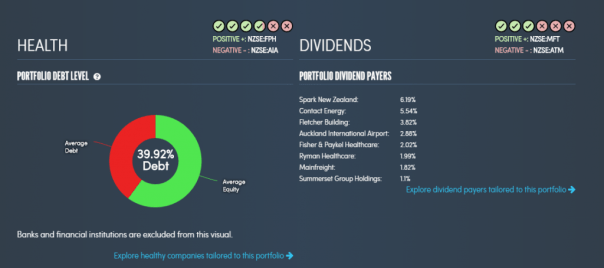
    Simply wall st dividends health chart

    Financial Health / Dividends

    A look at debt levels and the stability of the company.


    All of this gets distilled into one neat overview graph: The Snowflake. You can see it below – top right and in the left hand nav too. It’s a visual summary of the areas described above. The shape and colour of the snowflake is meant to give you a snapshot reading and enable easy comparison against other investments.

    simply wall st nz snowflake chart

    I was also able to see an overview of the individual companies this fund holds.

    Simply wall st holdings chartPlus, you can use Simply Wall St to find new investment ideas. For example, you might mine the database for stocks that are potentially undervalued, stocks with room to grow, or for stocks in certain industries. Grid views serve you up collections based on criteria you set.

    simply wall st grid chart

    I’m definitely a hands-off investor. That said, if that were to change, I would absolutely want Simply Wall St on my side – I can imagine making full use of it to research companies and guide my decisions.

    Are you a more active investor than I am? Keen to try Simply Wall St for yourself? Sign up for a free trial here.

  • The little things in life are so worth it

    I’ve been thinking lately about how little I’m actually doing to optimise my financial life on a micro level. Like, if I really wanted to hold on to every possible cent of my money, we would never buy produce at the supermarket. I would have my savings accounts organised differently to take advantage of the absolute best interest rate (still pretty abysmal, in today’s low rate environment). I would have a more complicated credit card set up to maximise rewards. I would catch the bus more to take advantage of bus ride mystery shops.

    I don’t. And I’m okay with that. I’m choosing to focus my headspace on the bigger picture and the choices that result in larger returns. Realistically, I can’t do both right now, and given the choice between macro and micro, I’m at the stage where it’s a no brainer to put time and energy toward the macro.

    I may not be optimising every single dollar these days, but I am trying to optimise my home life, even if it means spending some money.

    Seriously, I’ve been sweating the small stuff on some things that I really just need to get over. Sometimes it’s little things that make life so much more efficient and enjoyable. Yet it’s taken me over six months to suck it up and buy:

    Forks

    We’ve got enough knives and spoons to manage comfortably but for some reason, we’ve been getting by with only 3 forks. Finally, a 60% sale at The Warehouse prompted me to remedy this. And seriously, $6 for a bunch of new forks has been so worth it.

    Toilet roll storage rack

    I feel like such a grown up now. For real. Until now, they sat up on the windowsill – bit rugged, really.

    Coat rack

    Okay, this one isn’t quite done. Needs a little help from a friend (we don’t own a drill) so it’s still sitting on the dining table. But I got so sick of leaving jackets lying around everywhere, it was a no brainer!


    Still on the list of things I need, though:

    Shower caddy/rack

    Having bottles sitting on the floor isn’t ideal. But it’s just so clearly a want rather than an absolute need, I could keep putting this off indefinitely!

    Bedside lamps

    So I can stay up and read for a bit before bed without needing to have the full blown overhead light on.

    Photo montage frames

    I’ve still got a bunch more photos I need to get printed and stick on the wall … but they also need frames to go in.

    What little things improve your home environment?

  • 5 awesome books about money – for women, by women

    5 BOOKS about money for women - by women

    5 must read books about money for women

    I’ve been on a bit of a roll lately devouring books about money and career as I get closer to exiting the 20-something age bracket and ponder what my 30s could be like.

    In particular, I’ve been focusing on personal finance/career books by women. Here are some of the best I’ve read (affiliate links below):

    Secrets of Six-Figure Women: Surprising Strategies to Up Your Earnings and Change Your Life by Barbara Stanny

    Things Barbara Stanny and I have in common: We were female writers who didn’t earn huge amounts. Things we don’t have in common: Rich families, trust funds.

    That aside, this is not a book about Stanny, it’s about the many high-earning women she interviewed and the insights she has distilled into 11 chapters in Secrets of Six-Figure Women. Even though she began writing it before the GFC, her foreword notes that these women either survived the recession well, or were able to rebuild despite knockbacks. And as we find out, resilience is a key trait among high earners, among others. They aren’t groundbreaking secrets, but they are important reminders, and I suspect this is the kind of book you could come back to over the years for a fresh dose of motivation.

    Read it if you: Struggle with underearning (want to earn more, and are capable of earning more) and having belief in yourself.

    Gold Diggers and Deadbeat Dads: True Stories of Friends, Family, and Financial Ruin by Valerie Rinds

    I had a bit of a wakeup call in 2015 when I realised I was putting other people’s happiness ahead of my own, and making myself miserable. It was also severely damaging my own financial situation. I really needed to read this book back then – if only I had known about it!

    Gold Diggers and Deadbeat Dads mixes Rinds’ own story of financial hardship with other true tales of people who faced financial ruin thanks to the wrongdoing of other people. It’s entertaining, engaging and educational. And it’s a cautionary tale – choose your partners wisely, because they can make or break you financially. Rinds plays it straight – there’s no judgement here, just real stories told by real people.

    I think there’s often a fine line between victim blaming and accepting responsibility for your own choices; it’s definitely one I have struggled with myself. If you have caretaking and enabling tendencies, you may very well find loved ones taking advantage of you financially. It may not seem like it at first, it may not feel like it, and it’s an ugly, painful thing to wake up to.

    Read it if you: Struggle with financially supporting other people in your life and have trouble saying no.

    The Art of Money: A Life-Changing Guide to Financial Happiness by Bari Tessler

    Caveat: The Art of Money is a little hippy dippy, particularly to start off with. It’s not everyone’s cup of tea, but if it doesn’t put you off, then you might just find this a refreshing read.

    What spoke to me was the heavy emphasis on the emotional aspects of money. The first half is devoted to untangling your relationship with money, and the second tackles more practical aspects of money management, interwoven with the values and emotions that are all tied up in what we bring to the table when it comes to personal finance.

    I came to this book with a certain amount of regret and baggage that’s been weighing me down, and somehow I felt lighter for having made my way through it. Tessler’s incredibly compassionate approach and frameworks are the polar opposite of tough love – more like a warm bath or sustained hug. Sometimes, that’s just what you need.

    Read this if you: Struggle with bad money juju that you need to get past and let go of

    When She Makes More: 10 Rules for Breadwinning Women by Farnoosh Torabi

    It sucks that books like this exist, but IMO they are a necessary addition to the landscape. I will say right now that I didn’t find any new practical strategies in here, but it was at times thought provoking and most importantly, it brought voices to the forefront that are otherwise stifled.

    In an ideal world, it WOULDN’T matter who earned how much. But we live in the real world, with flawed workplaces and human relationships. How we feel about these things matters, just as much as how we deal with them.

    And that’s where I got the most value out of this book: reading stories of other women struggling with inequality, resentment, and navigating complicated dynamics. The emotional turmoil, I would argue, is the hardest to reckon with, and this book is a reminder that you are not alone.

    Read it if you: Struggle with being the breadwinner (there’s no shame in that)


    What Works for Women at Work: Four Patterns Working Women Need to Know by Joan C Williams & Rachel Dempsey

    I am not in law (or finance, or consulting, or any of those types of industries) and this book is definitely more targeted toward women in similar fields. I also count myself fortunate to not really have personally encountered sexism in the workplace so far. However, I know it exists and I have seen others run into it. And as I progress in my career and start thinking about how having a family might mesh with that, I found it interesting to read about the extra tightropes that working mothers walk. After all, career progression underpins finances, for most of us.

    What Works For Women At Work identifies the four main issues women encounter in the workplace – Prove It Again, the Tightrope, the Maternal Wall and the Tug of War – backed by research. It’s non judgemental and tries to take a big picture view as much as possible: it’s not just you, the system is actually broken. The advice on actually dealing with those biases is a little light, but as we all know, there are no quick and easy fixes in this area. We can do as much as we can as individuals, but real change and real solutions go beyond that.

    Read this if you: Struggle with progressing in the workforce and wonder why you aren’t getting ahead

  • Link love (the feeling-the-pinch edition)

    NZMuse - Link love roundup with awesome reads from the week

    Although we had a nice surprise last week coming in under budget for groceries, money has been flowing out seemingly non stop overall. We were meant to have 2 more months of flea treatment stuff for the dogs which has vanished; we’ve started our veggie garden; had to spend a fair chunk on dog-and-bird proofing it; replace a window the dogs shattered (glass panes down to floor level are NOT COOL); plus we’ve got our wall map project and my ongoing quest to get photos printed for the walls as well. Life!

    This week’s links

    Financial stability makes Mel thankful (I’ll drink to that!)

    Amanda has a hungry mortgage

    It’s about more than living within your means

    Dealing with financial shame

  • I like big bucks and I cannot lie

    Money stress? No thanks

    “Money is the biggest stressor in Kiwis’ lives, and it is the young that are feeling it most.” – Stuff

    Man, do I know that feeling. Money was the number one source of stress in my life for the majority of 2014 and 2015, and it was THE WORST.

    We spend most of our lives working for money, and you can’t get by in the world without it. My life has only improved as my income has risen. It is not the #1 factor in my career decisions, but it is a significant factor.

    I’m no longer ashamed to proclaim that I like, nay, LOVE, money. Like Bianca Bass, I’m taking a stand and putting it out there. She sums it up wonderfully in these three sentences.

    “Money is wonderful. It’s the difference between having choices and having none. It’s the difference between worrying about bills and having the mental space to think about more creative things.” – Bianca Bass

    Being broke is a time suck, and an energy suck. Things like navigating public transport in many cities, bargain shopping and researching every single purchase to save every possible cent takes up a huge amount of your time.

    They say wealth is the ability to fully experience life. Hell, even a modest existence requires money – and in New Zealand, quite a bit of money, actually.

    It’s not very PC to say that you like money and want more of it. People like to argue that money doesn’t solve all problems, that having too much money is just as big of a problem, etc… Which I just find so hilariously out of touch with most people’s realities. More of us than not are worrying about how to make ends meet, how to support a family, how to afford a comfortable retirement. Your average person is never going to have #richpeopleproblems – myself included.

    “I think about how much money I’m making and how I could find more of it, not out of greed but out of a pressing need to know that regardless of what happens, I will always be able to take care of myself. I love money for the security it represents. Worrying about money has been a defining characteristic of mine for as long as I can remember.” – Megan Reynolds

    Preach it… To me, money means options. It means peace of mind. I spent a solid chunk of time feeling panicked about money on a day-to-day basis. Downgrading that to mild worry has been awesome. I want to accumulate money, not for the sake of it, but for the security and freedom (ha yes, two slightly contradictory words) it brings.