fbpx
  • Link love (Powered by scallops and samosas)

    Lately I’ve found myself in some rather foreign situations.

    Taxiing multiple times a week (in a day, even)

    How do they arrive almost instantly after I hang up the phone to call for one? We’re out in the burbs; it’s not like there are rows of cabs lined up around the corner.

    The (horse) races

    I find this a strange, kind of anachronistic concept – very old school English – associated with a certain class of person, one to which a girl from the immigrant working class, who finds taxi chits and fancy restaurants daunting, most certainly does not belong.

    Yacht sailing

    Again, obviously such a moneyed activity. An enjoyable one, though. Also, very, very masculine. It was particularly interesting to see that the majority of fellow sailors were very courteous and friendly, in a crowded harbour, there was also anger – in one case outright yelling from boat to boat, and in another, simply holding up a peeved sign as our yacht passed by.

    Anyway, March has been madness on the events front and I’m hoping for/looking forward to a quieter, calmer April. It’s great to get out of the office from time to time but it does mean I get behind on all the other things I have to do.

    On a slightly different note… I know I’m often a ring-in, a seat-filler if you like, at events. Sometimes this works out quite nicely (in one case, dinner in a very quirky location and lots of freebies).

    But I’ve gotta wonder; do planners overbook for capacity? If so, by how much? And what does that mean when they STILL need to fill spots at the last minute?It has to be said, however, that too often they go overboard. I can’t count the number of inane event invitations that come our way that have zero value – publicity for boring product version 3.1.1.0, or with a deathly dull speaker nobody outside your company cares about – even with the most copious amounts of free and awesome food, there just isn’t any way to justify taking the time out to go.

    WORK

    I’m at Twenties Hacker pondering when it makes sense to freelance – and when it doesn’t pay

    One of the most balanced/nuanced takes on passion work vs plain old work I’ve ever read, from Get Rich Slowly. Two thumbs up

    And at Blog Maverick: Follow where your time and effort is, not necessarily your passion

    Young and Thrifty shares the worst jobs she did as a teenager

    At Journalistics, some tips for bringing online networking into the real world

    At Ms Career Girl, a counterintuitive way of dealing with workplace enemies

    FOOD

    How to plan dinner,at Dinner: A Love Story

    Chocolate peanut butter cheesecake. Enough said. From $120 Food Challenge.

    What looks like a straightforward, three-grain bread recipe, by Liberal Simplicity.

    LIFE, ETC

    Young and Thrifty shares the reasons that led her to quit Facebook.

    From the new crop of Stratejoy bloggers, a post on analysis paralysis and discovering values

    Yes and Yes features a reader who’s childless by choice

    Married with Luggage explains how to go about starting a kickass book club

    And finally, from the Atlantic: I didn’t tell Facebook I was engaged, so why is it asking about my fiance?

    This totally freaks me out. I will be really unnerved if this happens to me – I am still “in a relationship” on Facebook and plan to keep my status the same until we actually get hitched, and have participated in virtually no wedding/engagement talk anywhere on Facebook since.

  • On compromising in relationships

    Compromise.

    It’s the key to any good relationship.

    But what if you’re poles apart in your thinking?

    Back in my high school health/sex ed class, we were asked what one should do in a situation where one person wants to do a lot more physically than their partner is ready for.

    I don’t remember what the conclusion was, and in fact I’m not sure we actually got around to reaching one.

    Still, it’s an interesting question, no? What if two people in a relationship are at very different stages? What if one wants to move overseas/move in together/have a kid/get married and the other … doesn’t? Is meeting somewhere in the middle the best choice then, if it’s even possible – pressing one beyond their comfort limits while the other is just as dissatisfied?

    It seems to me, from my limited observations, that time fixes everything. Kinda.

    You start with talking it out.

    Then there’s panic and disbelief that you could ever be on the same page given how far apart you stand on matters.

    Then you wait. Wait and think and wash and rinse and repeat.

    Then at some point, it’s crunch time. If said issue is a dealbreaker and neither party’s stance has changed, then one is mostly likely going to walk away.

    Thoughts?

  • On blogging, identity and niches (plus a surprise bonus!)

    I’ve been thinking a lot lately about identity.

    It’s easier than ever these days to invent, or reinvent, yourself.

    I can think of a fair few people – online and in real life – who’ve started going by their first and middle names, or something else entirely.

    To be fair, in an age where your name is increasingly your brand, I can see why. Back when I dreamt, vaguely, of becoming famous somehow, I knew I didn’t have the right kind of name for it. Now of course, I have no interest in fame, and I’ve firmly established my byline with my very unglamorous moniker. Even it wasn’t a bit too late, I don’t know what kind of other name would suit me – perhaps I’m just not imaginative enough.

    And I’ve been thinking about my various footprints online. Between my accounts on all the usual social networking suspects, plus the likes of Quora, Instagram and other, more niche Kiwi sites (to say nothing of the many other social accounts I handle at work), it all adds up to quite a dizzying number.

    The consensus seems to be that one unifying personal brand is the way to go. So no multiple Twitter accounts, for example (something I’ve seen many people attempt to maintain, and fail – or to do poorly, retweeting links constantly from one account on the other, more popular one. Which seems rather, er, pointless).

    This is one area that I’ve actually made work, however. I share very different kinds of content on my bloggy Twitter account, compared with the tweets I send from my other personal account. On one, I chat to blog buddies, share fun links, inspiring links, and of course PF links. One the other, there’s a bit of quirk, there’s a bit of personal stuff, but there’s a lot more industry stuff and serious stuff – news articles and links about social media, communications and journalism. I don’t see a lot of crossover between the two, and unlike, say Google Plus, you can’t segment your updates by follower.

    Which I suppose brings me back to this blog. If the new paradigm is all about a strongly defined, overarching brand and theme, am I painting in too broad strokes here? Do I post too much local content when my readers are overwhelmingly overseas? Is my posting more frequently about books and food (which doesn’t garner many comments, but which I love, and seems to be bringing in new followers) too random for older subscribers?

    But when it comes down to it, building up separate niche blogs from scratch just falls under the too much work category. I’ve seen others succeed, and I’ve seen others fail.

    I’m going to wrap up by doing something I haven’t done on the blog before: sharing links to some neat stories I’ve worked on recently (if I do say so myself). Hopefully you’ll find an interesting read or two!

    Phoenix on the rise – the sharp young lady behind Phoenix Cosmetics, who started the label from scratch and is now known as the eyebrow queen.

    Coworking 2.0 down under – shared spaces are all the rage right now, and collaborative workspaces are popping up all over the show.

    The Go Vocab way with words – these young guys put me to shame with their clever language-learning venture.

    A bootcamp for gaming bootstrappers – it’s never been easier to start working for yourself, and game designers are well placed for entrepreneurship.

    Hapara, bringing classrooms into the cloud – a smart NZ startup blending Google and education, trying their fortunes in the Valley.


  • On fear

    Not long ago, a woman was brutally assaulted and raped in the grounds of a high school that I nearly went to, and that lots of my peers attended. In broad daylight.

    That led my dear mother to voice concern about the walkway that I take everyday on the way to work and back. It’s a path that winds over a creek, through bush, behind a school field, and that’s generally well away from main roads. It’s reasonably well frequented, however – by mothers with prams, runners, elderly people and schoolkids.

    As a woman – and particularly a small and physically weak one – I know I’m vulnerable.

    But I refuse to be cowed. I refuse to live my life in a permanent state of fear.

    Did we stop flying after 9/11?

    Do we give up driving after being hit by speeding drivers?

    There is good fear – fear of the worst case scenario that leads us to make plan B

    Fear of failure can go both ways – it can act as a motivator, or a paralyser.

    There’s social fear, something I know all too well and generally does no good.

    Fear of taking a leap into the unknown.

    And there are plenty more types of fear – you probably have a few close to your heart.

    There is caution, and then there is being afraid to live your life. It can be dangerous out there – that’s a fact – but the “scary world syndrome” reinforced by news coverage of crimes may raise our blood pressure levels unnecessarily.

    Attacks can happen to anyone. One of T’s good friends was badly assaulted while walking home one night from our apartment a few years ago.  He’s not big but is fierce and I’ve heard enough stories about him prevailing in fights at drunken parties – he can defend himself. Still, one person against a group has no chance.

    While I appreciate Mum’s concern, I’m not going to nearly double my daily journey just to stick to the main roads. After all, that’s no guarantee of safety either.

    I used to walk alone a lot in the dark. I worked well past sunset, and would walk home from the bus stop around 9pm (later sometimes). At our most recent abode, I often – not always – took a shortcut through a park with no lighting, even though it only saved me a couple of minutes. I probably wouldn’t do that today.

    I think it really boils down to this: avoid taking unnecessary risks. Nothing in life comes without an element of risk. Be smart about where you gamble.

  • Yes, you can.

    yes you can motivation inspiration<image via aigle_dore on flickr>

    Shaking up your life is terrifying.

    Too often we’re unhappy with the way our lives are going.

    And that’s not necessarily a bad thing. Acknowledging a problem is the first step toward rectifying it.

    But you have to know what you want.

    Ain’t no use wanting to make a change but not knowing what that change should be.

    That old adage – failing to plan is planning to fail – it’s true.

    It’s not enough to decide you want to be all Brad Pitt in Legends of the Fall and take off for years to do your own thing – kill zebras, sail on epic ships, visit Indian gurus and who knows what else – they were pretty vague in that film.

    You need an end goal and you need to lay out the steps to take to reach that point.

    And if you’re really committed to it, you’ll have to get past the fear.

    You’ll have to stop throwing up every conceivable barrier, every reason why you can’t.

    Maybe you’ll find you don’t really want to follow through. Fine.

    But if you DO, then you gotta balls up and take action.

    Tell me.

    Do you ever get frustrated by people who won’t take steps to take control of their own lives?

    And how do you determine whether you really, really want something, when it’s not something you can realistically trial beforehand?

  • The lives I’d like to lead

    Imagine the life you’d like to live, they say – and take steps toward making it a reality.

    One of my favourite reads this month came from Paranoid Asteroid, writing about the life she has vs the life she wants (albeit more a post about consumerism than anything else).

    Personally…

    English: Bullseye on a standard Harrows Bristl...

    Image via Wikipedia

    I’d like to be good enough to play in a band.

    I’d like to be an amazing cook.

    I’d like to be a blogger who makes lots of money blogging.

    I’d like to be part of a high-earning power couple.

    I’d like to be a travel nomad.

    I’d like to buy a house and put down roots.

    I’d like to be a frugal but stylish blogger who always looks put together.

    There is no way I can do all of these things.

    Part of finding balance is making choices.

    Pick the things that really matter.

    Identify the one, two or three goals that you truly care about, and attack them.

    That’s my deep thought for the day. Go forth and epiphanise (yes, I am making it a verb) for yourself.

  • Chewing over: Battle Hymn of the Tiger Mother

    This has got to be the most notorious book of the past year. You might recall seeing an extract from it in the WSJ, after which a gigantic firestorm erupted, with battle lines drawn between author Amy Chua’s supporters and detractors.
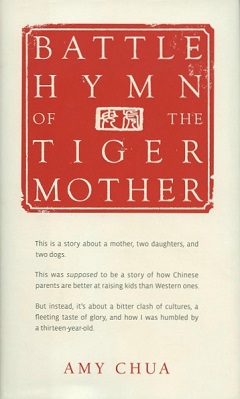
    Battle Hymn of the Tiger Mother

    Image via Wikipedia

    In a nutshell, this is a memoir about parenting, revolving largely around Chua’s quest to constantly push her daughters to excel at piano and violin respectively. There are no days off, even on holidays. There are no sleepovers, no other extracurriculars, no boys, definitely. A traditionally strict Chinese “tiger mother”, Chua’s methods work well on older daughter Sophia, a piano prodigy of sorts who goes on to play at Carnegie Hall. Younger daughter Lulu, however, is not as easy to mould. And it’s clear that if something doesn’t change in their relationship, she will lose Lulu forever.

    As she writes:

    “This was supposed to be a story of how Chinese parents are better at raising kids than Western ones. But instead, it’s about a bitter clash of cultures, a fleeting taste of glory, and how I was humbled by a thirteen-year-old.”

    And she concludes:

    “When Chinese parenting succeeds, there’s nothing like it. But it doesn’t always succeed.”

    Not since My Wedding and Other Secrets (which I cried in) have I had so much fun contemplating cross-cultural differences. I love her writing style; it’s clear, concise, immediately engaging, kind of self-deprecating.

    Here are some of my favourite passages:

    “By the time Sophia was three, she was reading Sartre, doing simple set theory, and could recognise 100 Chinese characters. (Jed’s translation: She recognised the words “no exit”, could draw two overlapping circles, and okay maybe on the Chinese characters).”

    “A tiny part of me regrets that I didn’t marry another Chinese person and worries that i am letting down 4000 years of civilisation.”

    “Jed’s parents gave him choices … and thought of him as a human being with views.”

    “Like every Asian American woman in her late twenties, I had the idea of writing an epic novel about mother-daughter relationships spanning several generations, based loosely on my own family’s story.”

    Chapter 5, On Generational Decline, struck a particular chord with me. There goes a common pattern: the first immigrant generation is the hardest working, building lives from the ground up. The second generation, aka Chua’s and mine (although in my case, technically still a first generation immigrant as I wasn’t born here) will typically go on to be high achieving professionals, less frugal than their parents, and often marry a white person (tick tick tick). The third generation – because of the hard work of their ancestors – will be born into middle class comforts, be surrounded by wealthy friends, expect all the trappings of middle class life, much more westernised and be more likely to disobey their parents.

    I know I definitely worry about this – I can’t imagine anything worse than raising a spoilt, entitled child. I don’t want my kids to be as petrified/cowed of me as I was by my parents for most of my life, but I would hope to instil a basic level of respect from the beginning. I want to encourage confidence and individualism, without allowing them to get away with anything they want.

    Let me be upfront about where I’m coming from. I didn’t have an Amy Chua for a mother. But mine was certainly more tiger than Western. I never ever nagged them for anything, never ever talked back, never ever challenged my parents, even if I knew I had reason to.

    Well, until I did. It was a battle of wills. They pushed, I pushed. I won. I moved out of home while still at high school, went on to win a full scholarship, got my degree, entered the working world. For the first few years, yeah, I kind of hated my parents. The conflict pushed me away, much like Chua’s own father distanced himself from his family. As Chua learns, every child is different. Having the flexibility to adapt is key.

    As Chua points out, Asian parents don’t generally blanch at comparing their offspring. This can be tough, especially when siblings are close in age, and one is clearly the more talented/driven. I was aware that I was that sibling, and my own mother expected more of me (which she articulated).

    I was a good daughter. I didn’t drink, do drugs, have sex (not that I was exactly awash in temptation even if I wanted to, being a total nerd). Was that ever appreciated? Nope, I only got exhorted to compare myself to those above me, rather than all those slack white kids. Sophia’s diatribe towards the end runs exactly along these lines – railing against that inescapable push to always aim higher, that nothing is ever sufficient.

    That said, personally, I’m a Chua supporter.  Unlike my family, she knew when to stop, although she very nearly didn’t. I think her methods were extreme – the screams, the threats, the spending every waking hour outside of school practising music. But her daughters do not actually hate her for that; they’re grateful. They achieved amazing things as a result. The same might not work for other families, but as we know, one size does not fit all.

    What I didn’t like about her? She comes across as a bit of a snob. Law and medicine were her only acceptable career paths – typical. She and husband Jed are well off by any standards – law professors who both have books to their name, who travel a lot and take multiple holidays a year. Not all of us can afford to live such a cultured lifestyle by her definition. (Sure, I wish my parents had taken us travelling more. We never went on holidays, domestic or otherwise. And yet, can I really blame them? I found myself perusing the specials board at the fish and chip shop the other day; a family pack was $20, and if our kids inherit our appetites, $30 is probably a more realistic figure. That’s Friday night dinner. And with bread nearly $2 a loaf and milk nearly $4 for two litres, even my dad’s so-called “simple meals” don’t cost what they used to.)

    Also, she slammed guitar and drums. (!!!) Granted, neither are as subtle or, perhaps, sophisticated as piano or violin. (I’ll speak as a 6-year dilettante school violinist who never even approached the bar of ‘adequate’. The fretless fingerboard, the bow, the awkward chin resting – it’s got to be one of the hardest instruments to conquer.) But do you know how much hard graft, coordination and rhythm a kickass drummer needs? Are you aware just how many techniques there are to be learned, across different kinds of drums, sticks, genres? And as a guitarist, I will also defend six-stringers. Music theory applies here, too – chords, scales – plus the huge variety offered by alternate tunings, and of course, learning to use sound effects effectively. Different does not have to mean inferior.

    Contemplating my future children

    This all got me thinking about what kind of a parent I want to be.

    I have always maintained I would not make the same mistake my parents did. But I also hope I don’t go too far in the other direction.

    Like Amy’s (white, Jewish) husband, T was raised in a totally opposite environment. And personally – I hate conflict. I like being liked. I’m stubborn, but not that stubborn. I am not a high energy person. And most of all, I do not want to fight my children.

    Ultimately, Battle Hymn is about a struggle for control. Chua decides her children must play a classical instrument. She chooses one for each, and sets out on a path to turn her daughters into stars.

    I disagree with this. And I personally see no reason to push my children into pursuing any activity professionally. That takes serious money (which we mostly likely won’t have) and time (which I simply am not prepared to give) – the exacting attention devoted to studying her daughters’ technique, the detailed practice notes she’d write, the office hours lost shuttling the girls to lessons, the hours of driving to another city to see their out-of-town music teacher every weekend. Of course, if they were to be truly amazing at something and wanted to do that of their own accord, that would be a different story.

    I also disagree with the notion that children owe their parents everything and personally I don’t subscribe to the whole filial piety thing (as I always used to shout at my father in my head “respect is earned!”).

    But I do believe in the quest for excellence and a strong work ethic – because it’s 90 percent hard work and 10 percent talent. It’s that tension, really, between helping your kids find what they like and exhorting them to stick with it. I fully agree with Chua that most things are not fun unless you’re good at them, which takes practice (and passion), which in turn often requires external motivation.

    Thinking back, I do sometimes wish my parents had pushed me more in a couple of regards – to continue with swimming (I can’t swim more than a stroke or two now), to get braces – or rather, stick with them through a second round – learning another language, even.  I wouldn’t call myself a quitter, but I do go through bursts and spurts of interest. Phases, if you like. Piano,  tennis,  violin and guitar (which I’ve gotten back into); songwriting. writing my great teen novel. While I am motivated enough to keep going with things that are truly important to me, I could’ve used a an extra push sometimes.

  • Should the student allowance be enough to live on?

    <via>

    Eavesdropping is one of my guilty pleasures. I like listening in to others’ conversations on the bus, in the office, wherever. (And most certainly on Twitter, where jumping into the stream is what it’s all about.)

    Sometimes, though, these conversations only serve to rark you up.

    Recent case in point: a discussion about the student allowance, and specifically how it’s not enough to live on.

    Right now, student allowance runs to a maximum of $167 a week, from what I can tell. If you’re in Australia, you can get another $40 in accommodation allowance for a total of $207. (If you don’t qualify for the student allowance, you can borrow $169 a week in living costs. This is never a good idea, because your loan balance will balloon like you cannot believe. But it’s an option.) And if you’re over 24 – a personal bugbear for me; why should you get more simply for being over an arbitrary age? – you qualify for up to $201 a week.

    You can’t live on that alone, I grant you. But it’s not so hard to get a job for 10 or 15 hours a week, and with that additional income, it’s certainly more than enough to eke out a reasonable standard of living. Your income in any one week can be up to $203.13 before tax before your allowance payments are affected.

    When I was studying, I received a total of $185 a week (the maximum back then). I was making maybe another $150 between my various hustles (I’ve always worked multiple jobs, although now my second gig consists of the very occasional mystery shop or essay editing gig).

    My basic expenses were $100 rent (I was living three stages out on the bus route), $30 for transport (an unlimited monthly pass), $50 or so on groceries (a princely sum compared to the $25/30 I spent during the last year of high school in which I lived on my own) and utilities worked out to around $30 a week.

    But I don’t want to live out in the burbs!!!

    Well, you could live closer to town, or in town, and cut out transport for a corresponding gain in rent (probably $150 or more but you might find a cheap room for around $120). Still doable.

    Yes, it’s an austere existence, but we don’t pay taxes so you can live it up while at uni.

    And if you can’t find a job (or can’t work one because you’re a medical student, etc), then living at home it is. Such is life.

    Worst case scenario, you left a small town in order to attend university and your parents can’t or won’t provide any financial help. That’s rough, and kind of leaves with little choice aside from racking up more debt. But as a student, you do at least have access to cheap loans and overdrafts (and potentially cheap credit cards; I can’t remember what the banks were offering in my day).

    Let’s face it, nobody ever promised that student allowance would provide for all your needs. As a nation we simply cannot afford such a luxury. It’d be nice to have $15 minimum wage and free medical and dental care for all. But these things just aren’t realistic for this (any?) country.

    What do you reckon? Classic entitlement attitude? Something worthy of tax dollars? Something in between?

  • Finding your healthy balance

    I don’t drink coffee, and I don’t smoke. I rarely drink alcohol, energy drinks or fizzy drinks; I don’t eat lollies, and I’m not big on meat.

    Fresh vegetables are important components of a...

    Image via Wikipedia

    That said, I’m a fiend for sugar in most other forms (baked goods and anything chocolate), carbs and many fried foods. And I’ll confess to a weakness for Yum Yum shrimp-flavoured noodles.

    I walk to and from work every day (20 minutes each way). I usually run twice a week (anywhere from one to 15km at a time) although this month I’ve been replacing one run with Zumba – one of my good friends is teaching free classes at Rocket Park in Mt Albert every Wednesday from 6.30pm if you’re keen.

    As with most things in life, I could do more. I could exercise every day. I could give up meat entirely or go vegan. (In theory. I love cheese and yoghurt too much to seriously contemplate the latter.)

    But I’m happy.

    What’s right for me and my body may not be right for anybody else.

    I’m one of those hateful thin people who can eat whatever she wants, so weight loss has never been a tangible motivator for me. (Apparently it’s okay for people to yell backhanded compliments at me while I’m out pounding the pavement.) I’m still yet to achieve my goal of giving blood because of my weight. So it’s got to be all me, all internally driven.

    I run to tone up and because somewhere along the way, I realised that between the panting, air-sucking and burning in my lungs, sweating it out physically felt good. I’m not saying it’s easy. But it’s worth it.

    Maybe I’m not a serious runner in some eyes because I can wear $20 Warehouse trainers and get away with it, and sometimes I only head out for a 15-minute jog. I’m okay with that – with admitting I really have no motivation to get my sweat on more often.

    I eat dessert almost every single day. And I usually have home-baked something or other for a snack at work. I still, more often than not, fail to make 5+ a day. I don’t like very many fruits and I prefer my vegetables cooked – and I need my carbs in order to keep my ridiculously fast metabolism up so I’m not scrounging around for more food every half hour. I’ve learned to like greens about 1000 times more than I did two years ago, but plant matter alone inevitably leaves me feeling hollow before long.

    Right now, this is my life. This is what my balance looks like.

  • Friendships of the double x chromosome

    Original caption: Ne ties a friendship bracele...

    I recall reading on a blog once that one thing (among a long list) that men can never understand is the complicated dynamic of female friendships.

    Maybe it’s just me, but I’ve never had a fight with a friend. Male or female.

    During school, there have been times when my friends and I tried to run away from a girl who wanted to be friends with us. Real mature, I know.

    I’ve had friends turn on me or ditch me for various reasons, then come back to me.

    I’ve been jealous of friends striking up closer bonds with other friends than with me.

    And sometimes been insecure in my place as one of a few girls in a mainly male social circle.

    But a proper throwdown, shouting or silent-treatment argument?

    Never.

    That said, rivalry has played a part in a couple of friendships for me. I think that it was mainly one-sided (ie, in my head), to be honest. But the outcomes were very different. One I still consider a friend, if not a close one; the other, an acquaintance whose social circles sometimes overlap with mine – we can play nice together socially, but you wouldn’t catch us hanging out by ourselves.

    In the first case, we instantly bonded upon meeting in school – we were both emo, introspective soulmates, sarcastic, tough, too clever for our own good. We were good at many of the same things and almost went to the same university to do the same degree. I was glad she didn’t, to be honest. I would’ve gotten too competitive, and I don’t think it would have been healthy for us. I always saw her as a spunkier, more charismatic me (perhaps what I should aspire to be in a parallel world) and in my younger, more insecure days, sometimes that was a bit threatening. Don’t get me wrong; while she can be a hard case, she has a big heart, and I’ll never forget her taking me under her wing after my first big breakup. I admire her hugely, and she’s the only person I know who’s been toughing it out on her own longer than me, having been largely independent since about 14.

    For various reasons we drew apart. We studied different things, but now work in similar fields, which brought us closer together. I honestly think that we’ll be able to catch up once every three, five, ten years and still get along awesomely, no matter where our life paths take us.

    In the second case, we met, I think, through mutual friends. We were good time friends, and that’s how it always was. We were part of the same crew, hanging out after school and on weekends. I thought we had a lot in common. And I thought possibly we could be good friends, if not necessarily BFFs.

    Thing is, at the core of it, she was simply cold. There were some people she treated extremely well, and others who seemed just pawns to her. It was tough to relate to someone who’d never had to work for anything. She was kinda vain (and more photogenic, if not downright better-looking than me. I suppose that’s where the competition was at, in my head, but at least I always had nice-ness on my side, for whatever that’s worth). And ultimately, she talked shit about me. (There’s discussing your friends behind their backs, in private. And then there’s straight bitchy comments – not the kind you would ever utter aloud about a true friend – just while you’ve stepped out of the room, to their flatmate, of all people. Plus trolling your blog.)

    I’m really curious to hear your thoughts on female friendship. And have you ever had one of a competitive nature, real or imagined?